
Book 6, Question 28
Why Do Fish Have Scales?
Fish have scales mainly to protect their bodies, and scales also help them slip through the water.
Scales are thin plates that cover a fish's body. They protect the fish and help it slip through the water. They also grow as the fish grows.
Watch the videoWatch on YouTubeSee the series on Amazon
Quick answers
Do all fish have scales?
No. Some fish, like clingfishes, have no scales and are protected by a thick layer of mucus instead.
Source: australian.museum
From the book
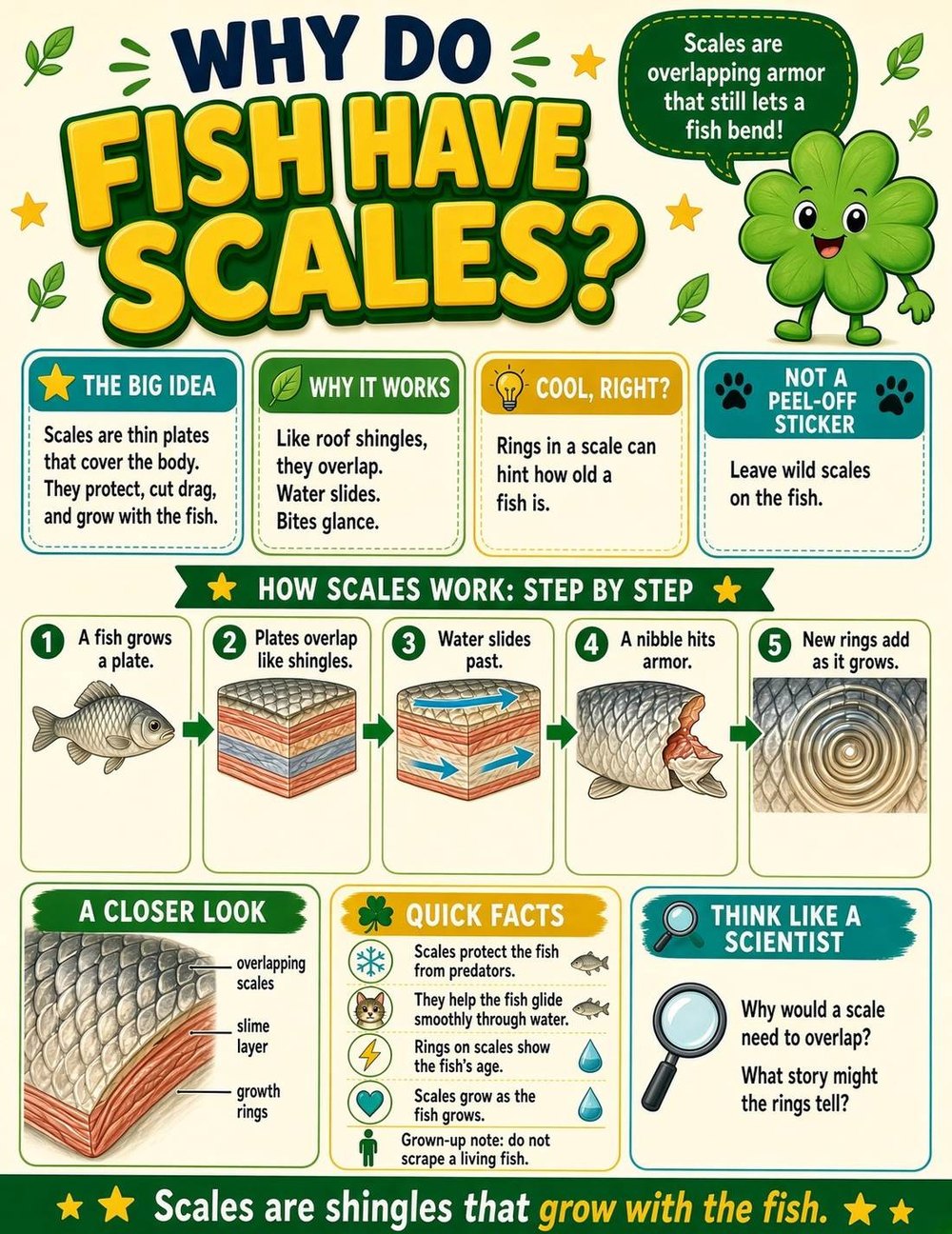
Page from A Million Whys Book 6
More fun facts
- The main job of scales is to protect a fish's body from the outside world.
- There are four main kinds of fish scales, with many variations of each.
- Some fish, like clingfishes, have no scales at all and are protected by a thick layer of mucus instead.
- Freshwater eels have tiny scales tucked into their skin, and tunas have tiny scales only in certain areas.
- The scales of the Indian mahseer can grow more than 10 centimeters long.
- Tarpon scales are so big that people have used them in jewelry.
- As some scales grow, they form rings called circuli that look a bit like tree rings.
Sources: australian.museum
Questions kids ask
Do all fish have scales?
No. Some, like clingfishes, have no scales and are protected by a thick layer of mucus instead.