
Book 7, Question 17
Why Is There Fog Near Lakes and Rivers?
There is fog near lakes and rivers because water evaporates into cooler air above them until the air is full and fog forms.
Lakes and rivers keep adding invisible water vapor to the air above them. When cool night air settles over that moist air, the vapor can turn into tiny droplets. That wraps the shore in fog, like a humidity hug.
Watch the videoWatch on YouTubeSee the series on Amazon
Quick answers
What is this fog called?
This kind of fog is called evaporation fog, steam fog or even sea smoke.
Sources: NASA Science, NOAA, NOAA
From the book
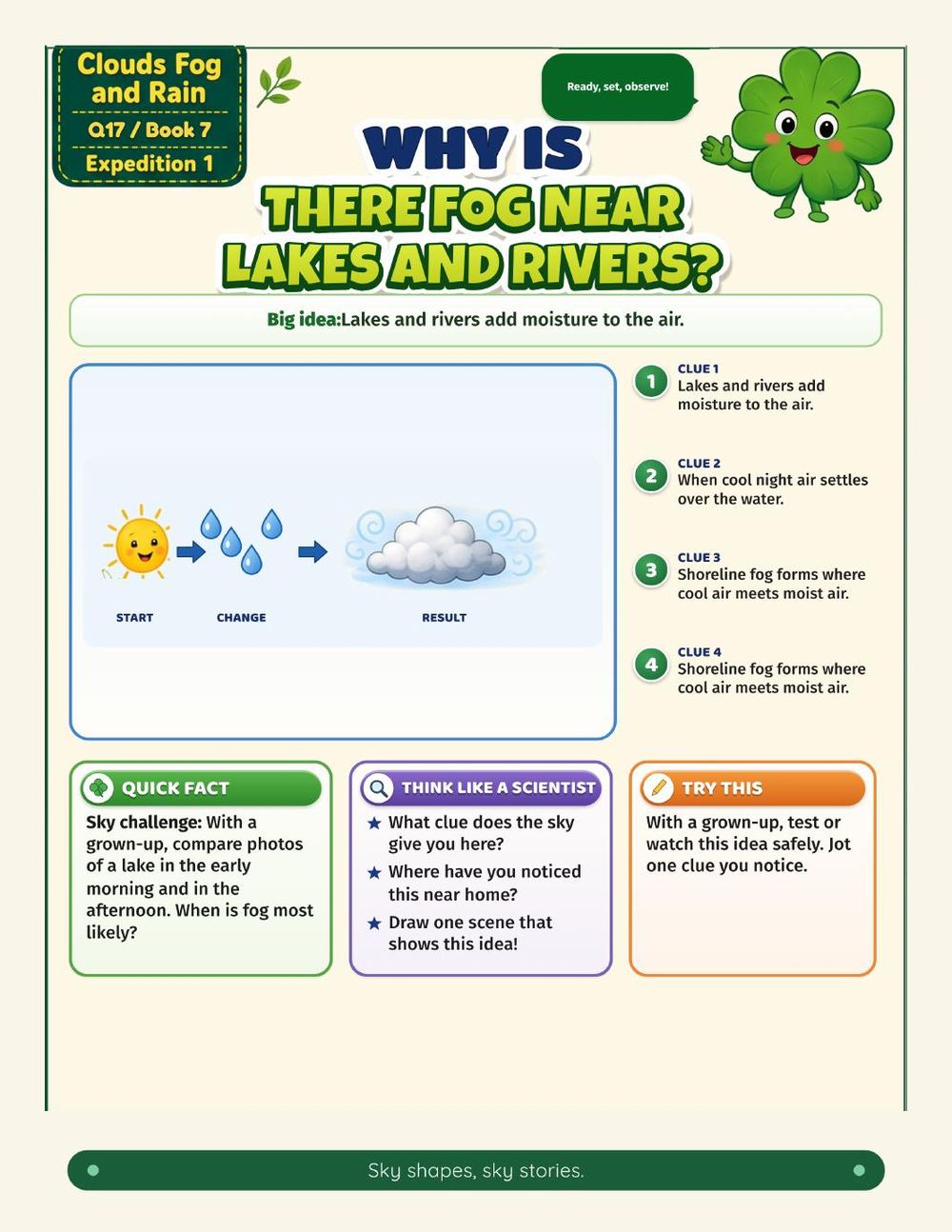
Page from A Million Whys Book 7
More fun facts
- When cold air flows over warmer water, water evaporates into the cold air until the air is completely full of moisture.
- This kind of fog is called evaporation fog, steam fog or even sea smoke.
- In 2011, a NASA satellite photographed steam fog that covered almost exactly the shape of Lake Baikal in Siberia.
- Lake Baikal is about 25 million years old and about 5,600 feet deep, the oldest and deepest lake in the world.
- Steam fog is often seen over the Great Lakes.
- Advection fog forms when warm, moist air moves over a colder surface.
Sources: NASA Science, NOAA, NOAA
Questions kids ask
What is sea smoke?
Fog that forms when cold air moves over warmer water. It is also called steam fog.
What is the deepest lake in the world?
Lake Baikal in Siberia, about 5,600 feet deep.