
Book 5, Question 113
Double Check! Why Is Peer Review a Filter?
Peer review is a filter because other experts check a scientist's work for mistakes before it is published.
In peer review, other experts read a scientist's work before it is published. They look for mistakes, missing evidence, and unclear ideas. It helps make sure that published science has been checked carefully.
Watch the videoWatch on YouTubeSee the series on Amazon
Quick answers
Do most journals use peer review?
Almost all scholarly journals use peer review to filter out bad science and spot weak data analysis.
Sources: U.S. Geological Survey, Scientific American, Scientific American
From the book
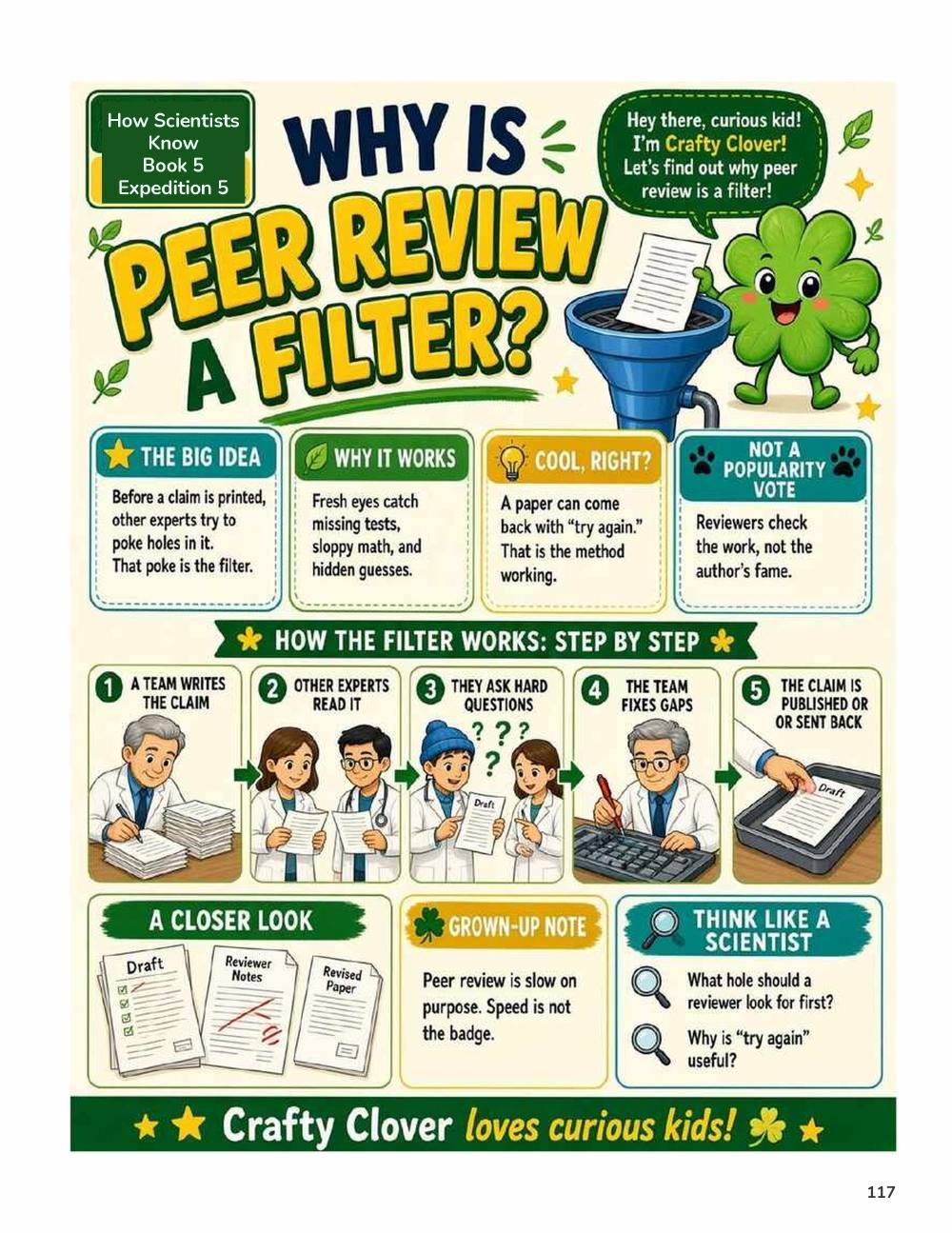
Page from A Million Whys Book 5
More fun facts
- In peer review, other experts in the same field check a scientist's work before it is published.
- Almost all scholarly journals use peer review to filter out bad science and spot weak data analysis.
- Reviewers also suggest ways to make the work better.
- For busy readers, peer review works like a filter, so they have less to read to keep up.
- Peer review is not perfect. Reviewers can have biases, just like anyone else.
- Over long stretches of time, peer review helps science move closer to the truth through shared fact-checking.
Sources: U.S. Geological Survey, Scientific American, Scientific American
Questions kids ask
What is a peer in peer review?
Here, a peer is another expert who works in the same field.