
Book 3, Question 53
Why Do Skyscrapers Sway?
Skyscrapers sway because tall buildings are designed to bend a little in wind and earthquakes so they don't crack.
Tall buildings are designed to bend a little, in wind and in earthquakes. A stiff tower would crack, but a gentle sway safely dumps the energy. So skyscrapers really do move!
Watch the videoWatch on YouTubeBuy on Amazon
Quick answers
Are short buildings different?
Short buildings are stiffer than tall ones.
Sources: Exploratorium, BBC, BBC, Smithsonian Magazine
From the book
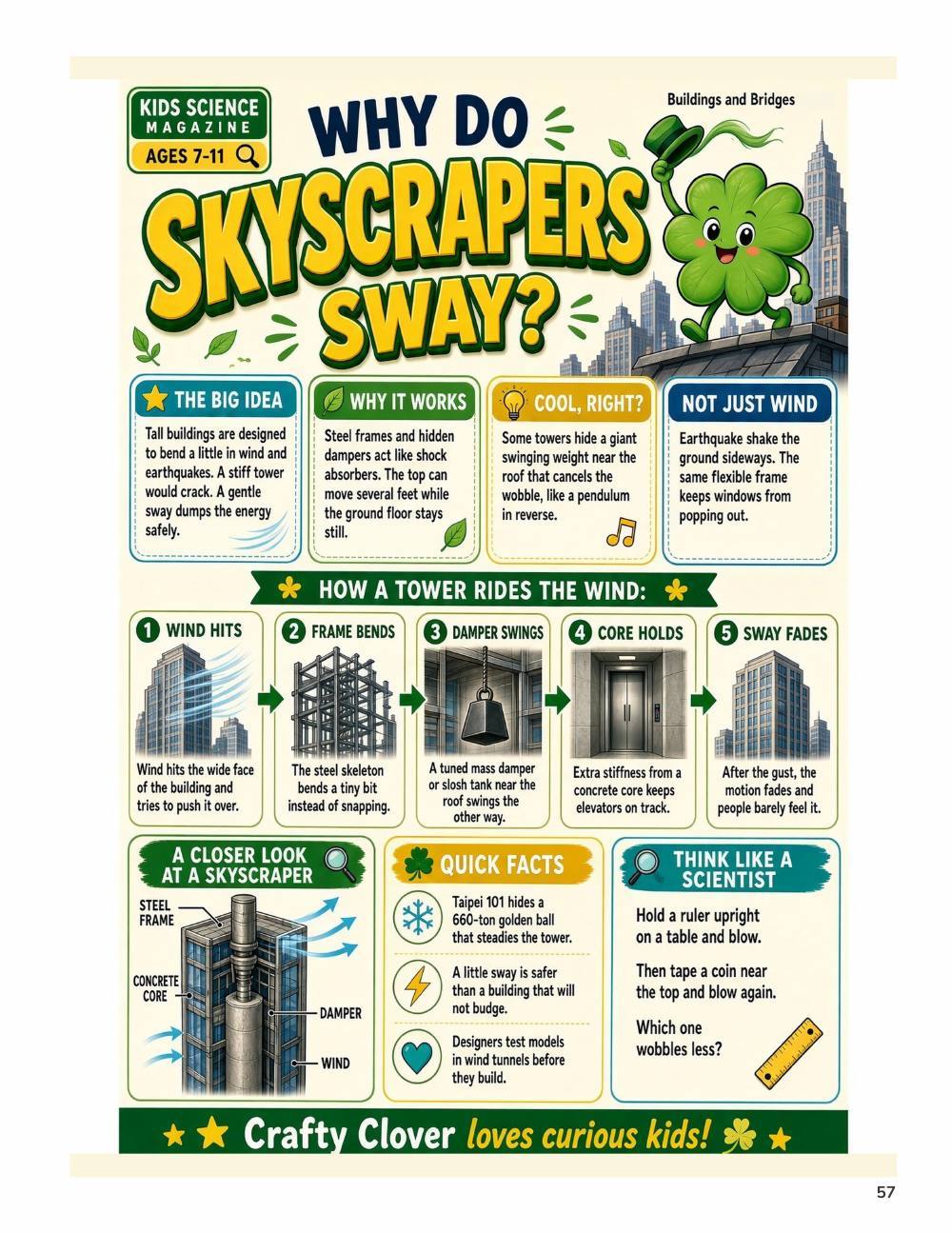
Page from A Million Whys Book 3
More fun facts
- Tall buildings cannot avoid swaying, so engineers design them to sway safely.
- In an earthquake, the shaking ground makes a building sway as the quake's energy moves through it.
- Short buildings are stiffer than tall ones, so a three-story building can be more at risk in an earthquake than a 30-story skyscraper.
- The more flexible a building is, the less energy it takes to keep it from toppling when it sways.
- Skyscrapers let a very big building fit on a fairly small piece of land.
- The world's littlest skyscraper, in Wichita Falls, Texas, is only about 12 meters tall. Its plans said 480 inches, not the 480 feet investors expected.
Sources: Exploratorium, BBC, BBC, Smithsonian Magazine
Questions kids ask
Is it scary that skyscrapers sway?
No. Big skyscrapers are designed to sway in the wind, so it is nothing to worry about.