
Book 2, Question 142
Why Does the Ground Shake?
The ground shakes in an earthquake when stuck rocks along a fault suddenly slip and release energy as seismic waves.
Sometimes the ground trembles. That is called an earthquake. Giant plates can slip! Most shakes are small. Some places have earthquakes more often than others, mostly near the edges of plates.
Watch the videoWatch on YouTubeBuy on Amazon
Quick answers
What is Earth's surface like?
Earth's outer skin is broken into many pieces, like a giant puzzle.
Sources: U.S. Geological Survey, U.S. Geological Survey, U.S. Geological Survey
From the book
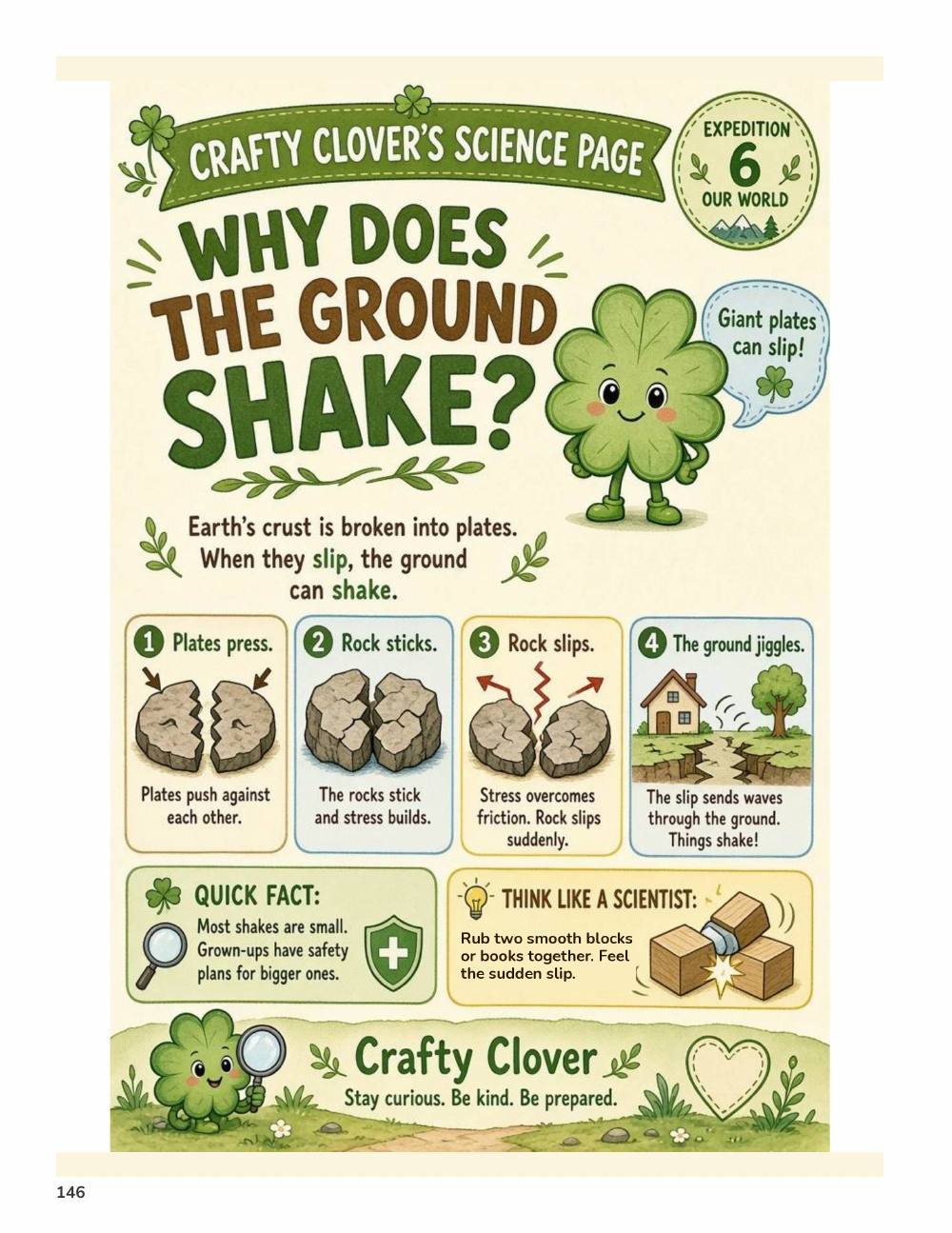
Page from A Million Whys Book 2
More fun facts
- Earth's outer skin is broken into many pieces, like a giant puzzle.
- Along a fault, rocks can stay stuck while energy slowly builds up.
- When the stuck rocks finally slip, the stored energy spreads out as seismic waves, like ripples on a pond.
- Earthquakes are recorded by instruments called seismographs. The base shakes with the ground while a heavy hanging weight stays still.
- Shaking is stronger for bigger earthquakes and gets weaker farther from the fault.
- Strong shaking can even make wet ground act like a liquid. This is called liquefaction.
Sources: U.S. Geological Survey, U.S. Geological Survey, U.S. Geological Survey
Questions kids ask
What is an epicenter?
The spot underground where an earthquake starts is the hypocenter. The spot on the surface right above it is the epicenter.