
Book 1, Question 127
Why Does Ice Float? Water's Roomy Crystals!
Ice floats because when water freezes, its molecules link up and hold each other apart in a roomy crystal that is less dense than liquid water.
Most solids sink in their own liquid, but ice floats! When water freezes, it locks into a roomy crystal made of hexagons, and the extra empty space makes ice less dense so it floats. The page compares liquid water and ice molecules side by side. It also says ice lids keep lake water liquid for fish. Drop an ice cube and a small rock in water to see which sinks.
Watch the videoWatch on YouTubeBuy on Amazon
Quick answers
Is sea ice salty?
Sea ice has only about a tenth as much salt as seawater, because salt doesn't fit into ice crystals.
Do melting ice cubes raise the water level?
No. Melting ice cubes in a glass of water won't change the water level.
From the book
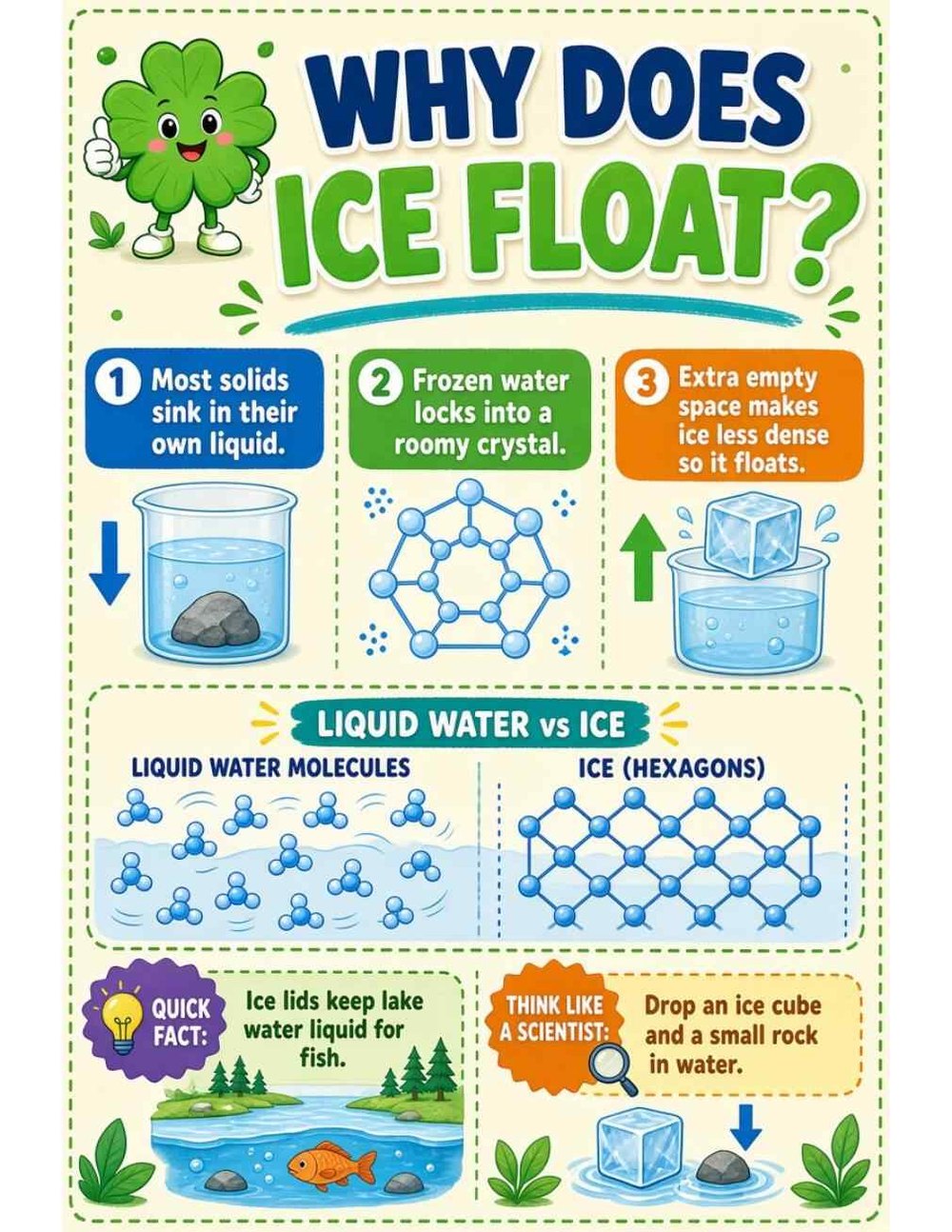
Page from A Million Whys Book 1
More fun facts
- As water cools toward 40 degrees Fahrenheit (4 degrees Celsius), it gets denser, just like most things do.
- Below that, water molecules start linking up and holding each other apart, so the water expands and gets less dense.
- Sea ice has very little salt, only about a tenth as much as seawater, because salt doesn't fit into ice crystals.
- New sea ice can trap pockets of salty water called brine, but the brine slowly gets pushed out.
- Melting ice cubes in a glass of water won't change the water level.
- Floating sea ice is fresh water, so when it melts into the salty ocean it raises sea level just a tiny bit.
Questions kids ask
Is sea ice salty?
Only a little. It has about a tenth as much salt as seawater.
Does melting ice raise the water in my glass?
No. Melting ice cubes in a glass of water won't change the level.