
Book 1, Question 122
Why Do Balloons Stick to Your Hair? Static Electricity!
Balloons stick to your hair because rubbing moves electrons from your hair to the balloon, and the opposite charges pull together.
Rub a balloon on your hair and it clings like magic, but it is really static electricity. Rubbing moves tiny charges, so the hair and the balloon end up with opposite charges. Opposite charges pull on each other, so the balloon clings. The page says this is static electricity, not glue. Rub a balloon on a sweater and then stick it to a wall to try it yourself!
Watch the videoWatch on YouTubeBuy on Amazon
Quick answers
What is this called?
Scientists call the rubbing effect triboelectric charging.
Can static be powerful?
Yes. Bits of volcanic ash rubbing together can spark lightning over a volcano.
Sources: Smithsonian Magazine, CASE
From the book
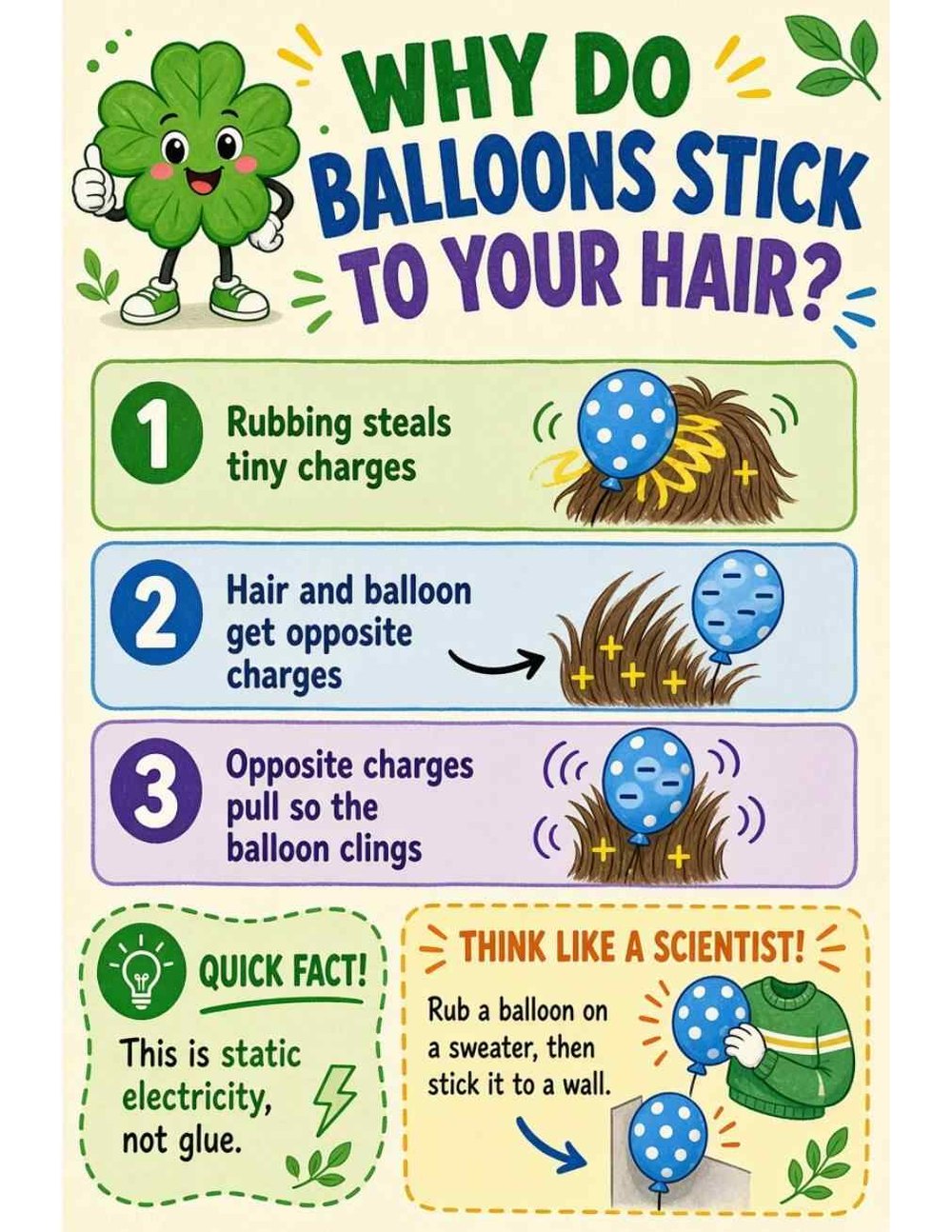
Page from A Million Whys Book 1
More fun facts
- When you rub a balloon on your hair, tiny particles called electrons jump from your hair to the balloon.
- That leaves your hair with a positive charge and the balloon with a negative one, and opposite charges pull together.
- Scientists call this rubbing effect triboelectric charging.
- Scientists have studied static electricity for centuries, and parts of it are still a mystery.
- Bits of volcanic ash rubbing together can build up enough static to spark lightning over a volcano.
- Static sparks can be dangerous in places with lots of fine dust, like flour mills and coal mines.
- Static can also be useful. It helps car paint and some farm sprays stick better.
Sources: Smithsonian Magazine, CASE
Questions kids ask
Why does a balloon stick to my hair?
Rubbing moves electrons to the balloon, so the balloon and your hair get opposite charges that pull together.
Can static electricity cause lightning?
Yes. Bits of volcanic ash rubbing together can spark lightning above volcanoes.