
Book 1, Question 109
Why Do Boats Float? The Secret of Buoyancy!
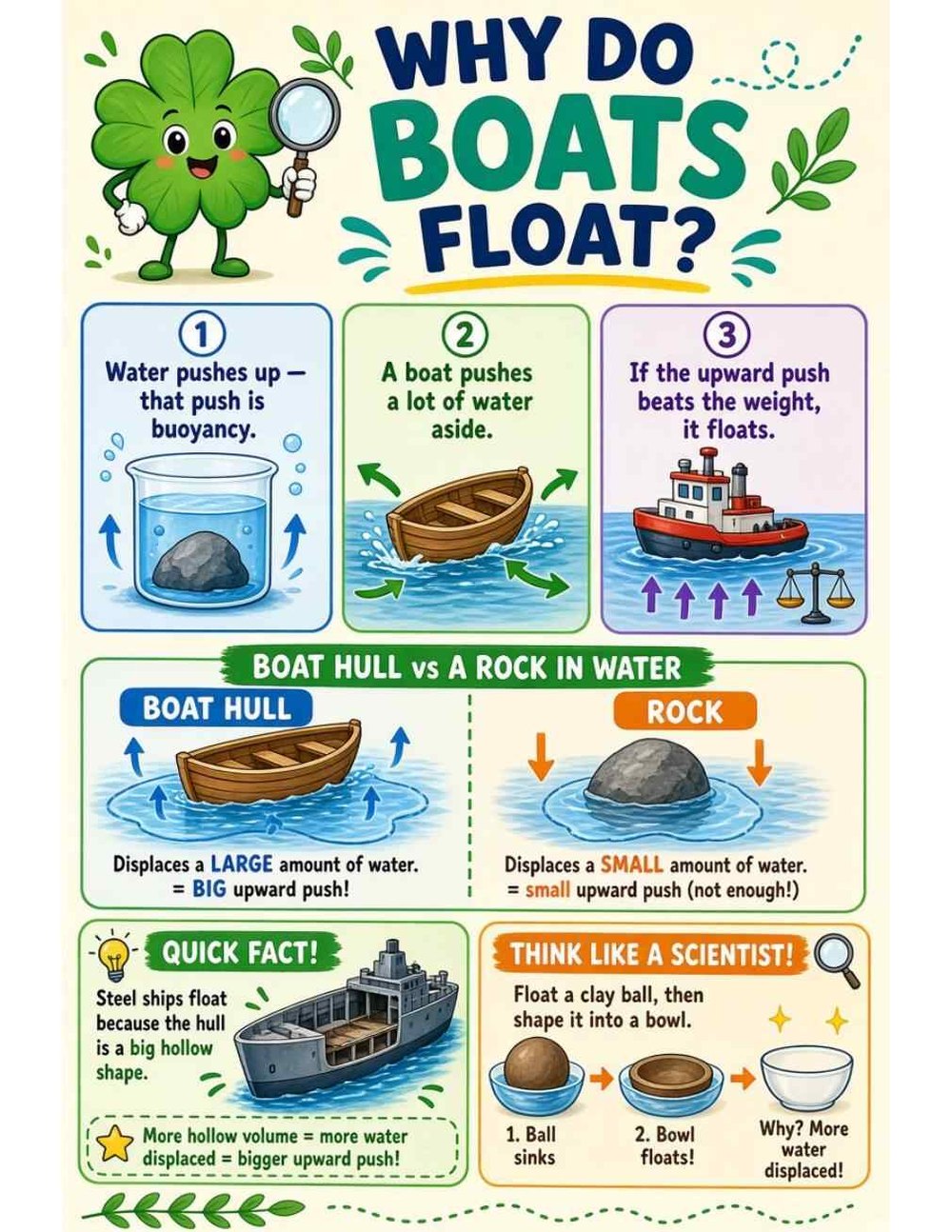
Boats float because water pushes up on them with a buoyant force equal to the weight of the water they push aside.
A giant steel ship can float while a small rock sinks, and it is all about pushing water aside. Water pushes up on things, and that push is called buoyancy. A boat pushes a lot of water aside, and if the upward push beats its weight, it floats. Steel ships float because the hull is a big hollow shape, so more hollow volume means more water displaced and a bigger upward push. Float a clay ball and then shape the clay into a bowl to see it yourself!
Watch the videoWatch on YouTubeBuy on Amazon
Quick answers
What is Archimedes' principle?
The buoyant force equals the weight of the water an object pushes aside. It explains why steel ships float.
How do submarines rise and sink?
By changing what is inside their ballast tanks. Fish use a swim bladder.
From the book
Page from A Million Whys Book 1
More fun facts
- The upward push of water is called the buoyant force, and it is there whether an object floats or sinks.
- The buoyant force equals the weight of the water an object pushes aside. This is called Archimedes' principle.
- Archimedes' principle explains why ships made of steel can float.
- Submarines rise and sink by changing what is inside their ballast tanks.
- Fish move up and down in the water using a body part called a swim bladder.
- In a NOAA activity, a flat sheet of foil soon sinks, but foil folded into a wide boat shape floats and carries weight.
- Your arms feel heavier when you get out of a bath because the water is no longer holding them up.
Questions kids ask
Why does a steel ship float?
Its shape pushes aside a lot of water, and the water pushes back up with a force equal to that water's weight.
How do submarines sink and rise?
They change what is inside their ballast tanks.