
Book 1, Question 106
How Does a Light Bulb Work? Filaments vs. LEDs!
An old-style light bulb glows when electricity heats a thin filament, while an LED makes light from layers of a semiconductor material and uses much less energy.
In an old-style bulb, electricity flows through a thin part called a filament, and it gets so hot that it glows. LED bulbs glow with tiny chips and give off less heat. The page says most of an old bulb's energy is heat, not light, which is why they get so hot. Feel a lamp shade after the lamp has been on, and never touch the bulb!
Watch the videoWatch on YouTubeBuy on Amazon
Quick answers
What does LED stand for?
Light-emitting diode. A diode lets electricity flow only one way.
What decides an LED's color?
The semiconductor material it is made from.
Sources: Science News Explores, NASA
From the book
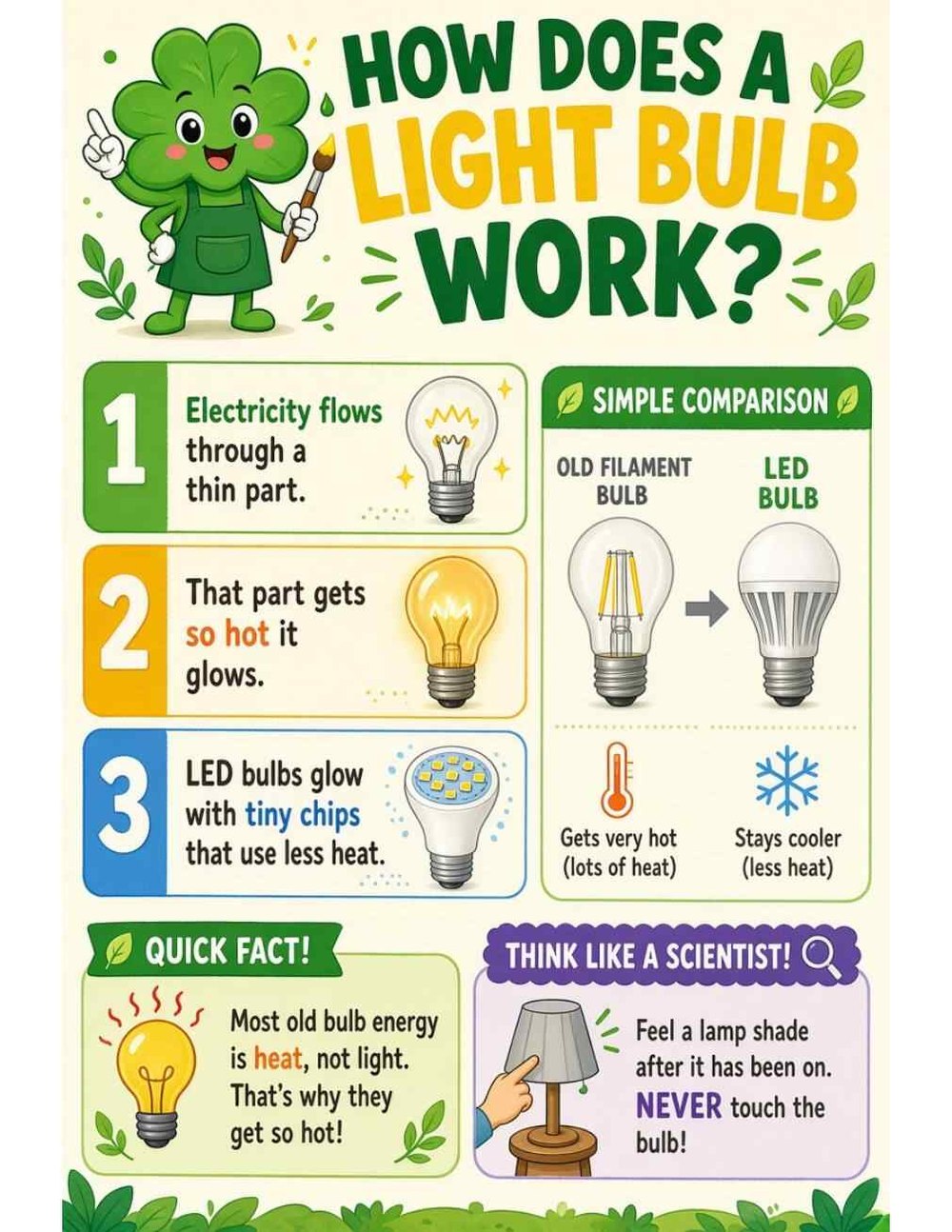
Page from A Million Whys Book 1
More fun facts
- LED stands for light-emitting diode. A diode is a part that lets electricity flow only one way.
- An LED has two layers of a special material called a semiconductor. When they work together, they give off light.
- The color of an LED's light depends on what semiconductor material it is made from.
- For the same amount of electricity, LEDs make more light than old-style or fluorescent bulbs.
- LEDs light up traffic lights, TV screens, car tail lights and holiday lights.
- NASA tested LED lights at its rocket engine test stands to save energy, and found that keeping LEDs cool helps them last much longer.
Sources: Science News Explores, NASA
Questions kids ask
What does LED stand for?
Light-emitting diode.
Why do LEDs come in different colors?
The color depends on the semiconductor material inside.