
Book 1, Question 57
Why Do Earthquakes Happen? Slipping Slabs of Rock!
Earthquakes happen when huge slabs of rock along a fault get stuck, build up stress and then suddenly slip, sending out waves of energy.
Earthquakes begin deep underground when huge slabs of rock called plates move very slowly. Sometimes the plates get stuck at a fault while the force keeps pushing, so stress builds up. When the stress gets too big, the rock slips and energy races out as seismic waves. The page says most big earthquakes happen at plate edges, where the stress is greatest. Try pushing two book spines together until one slips to model it.
Watch the videoWatch on YouTubeBuy on Amazon
Quick answers
What was the biggest earthquake ever recorded?
A magnitude 9.5 in Chile on May 22, 1960.
How often do earthquakes happen?
Thousands happen every day around the world, but most are too small to feel.
Does the Moon have quakes?
Yes. Moonquakes are smaller and less common than earthquakes.
Sources: U.S. Geological Survey, National Geographic
From the book
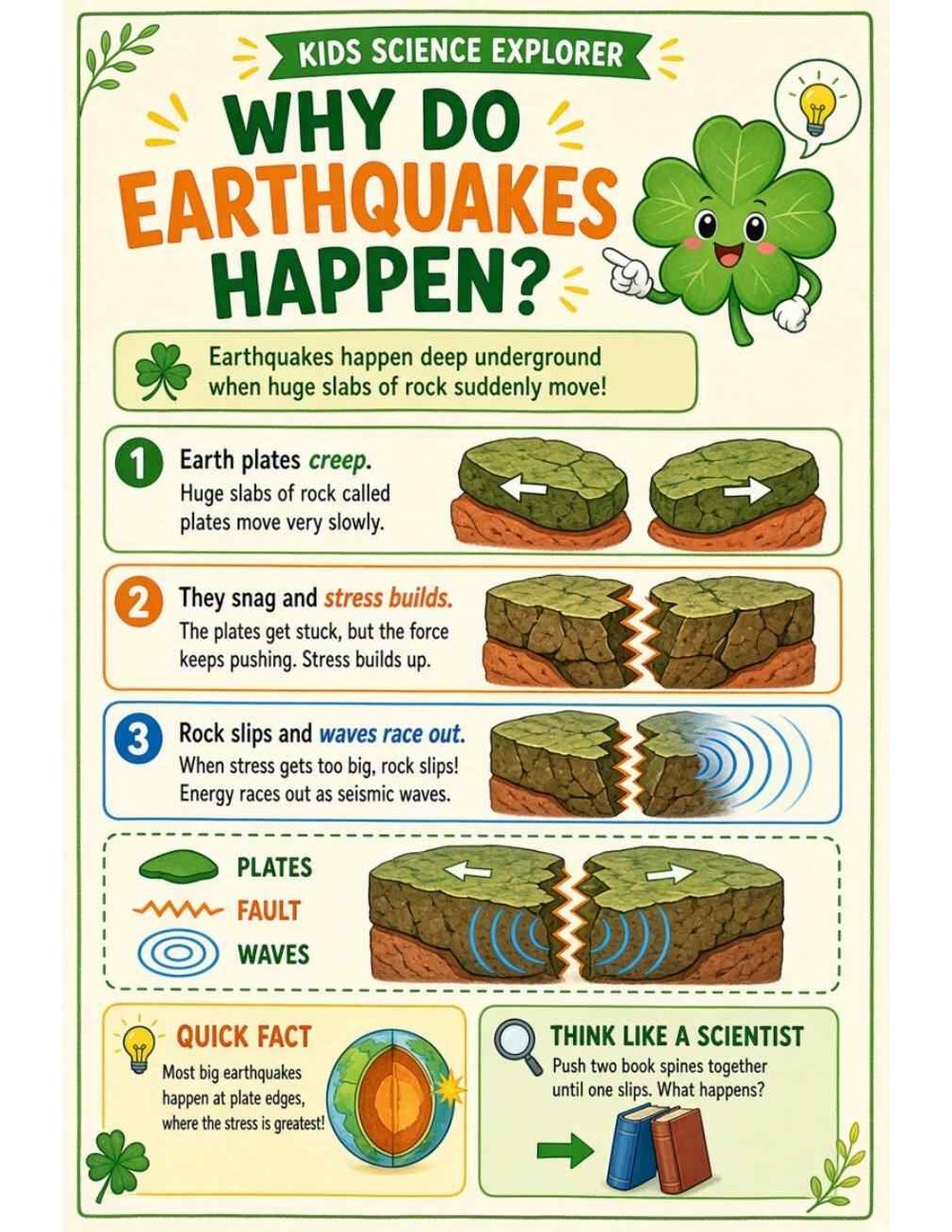
Page from A Million Whys Book 1
More fun facts
- Thousands of earthquakes happen every day around the world. Most are too small to feel.
- The largest earthquake ever recorded was a magnitude 9.5 in Chile on May 22, 1960.
- The largest recorded earthquake in the United States was a magnitude 9.2 in Alaska in 1964.
- The fastest earthquake wave is called the P wave. It is the first to arrive.
- The two sides of California's San Andreas Fault slide about 2 inches a year. At that rate, Los Angeles and San Francisco would sit next to each other in about 15 million years.
- The Moon has quakes too. Moonquakes are smaller and less common than earthquakes.
- Earthquakes under the ocean can cause tsunamis that reach shores thousands of miles away.
Sources: U.S. Geological Survey, National Geographic
Questions kids ask
How many earthquakes happen each day?
Thousands, but most are so small that nobody feels them.
Does the Moon have earthquakes?
Yes. They are called moonquakes, and they are smaller and happen less often than earthquakes on Earth.