
Book 1, Question 47
Why Do Octopuses Seem So Smart? Eight Clever Arms!
Octopuses seem smart because they have large brains for invertebrates and many neurons in their arms, which help them learn, solve problems and even use tools.
Octopuses have big brains for invertebrates, which helps them learn, remember and solve problems. Their arms are packed with neurons, so the arms can act on their own, and special cells in the suckers can taste chemicals in the water. The page says more than half of an octopus's neurons are in its arms, like having eight smart helpers. Octopuses also change color and texture to hide, hunt and stay safe, so see if you can spot one matching a rock.
Watch the videoWatch on YouTubeBuy on Amazon
Quick answers
How many neurons does an octopus have?
The common octopus has around 500 million neurons, about as many as a dog, and more in its arms than in its brain.
What else is unusual about octopuses?
They have blue blood, three hearts and a doughnut-shaped brain.
Sources: Natural History Museum, London, Uchicago
From the book
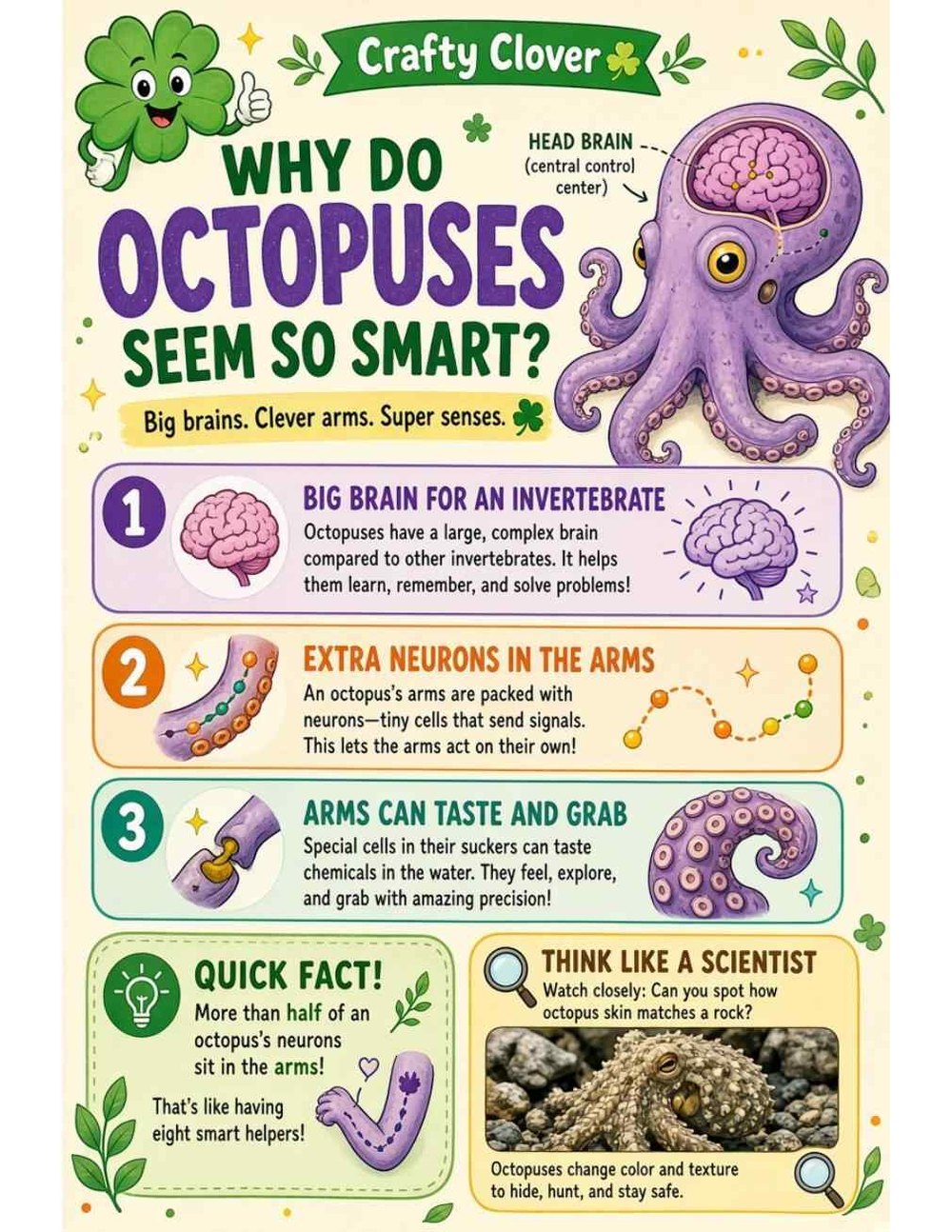
Page from A Million Whys Book 1
More fun facts
- Octopuses have blue blood, three hearts, and a doughnut-shaped brain.
- The common octopus has around 500 million neurons, about as many as a dog.
- Across all eight arms, an octopus has more neurons than in its brain.
- Each arm can taste, touch, and move on its own, but the main brain can still take charge.
- An octopus can move each of its suckers separately.
- Octopuses are one of the very few invertebrates known to use tools. In the wild they build little dens and use stones as shields for the entrance.
- In Indonesia, veined octopuses were seen collecting coconut shells and carrying them around to use as shelters later.
Sources: Natural History Museum, London, Uchicago
Questions kids ask
How many hearts does an octopus have?
Three. Octopuses also have blue blood.
Do octopuses use tools?
Yes. Veined octopuses carry coconut shells to use as shelters, and wild octopuses use stones to guard their dens.