
Book 1, Question 41
Why Is Spider Silk So Strong? Spiders' Super Thread!
Spider silk is strong because its proteins, called spidroins, line up and lock together as the liquid silk is spun into threads.
Spider silk starts out as a liquid protein inside the spider's gland. As it is pulled into a fiber, the protein molecules line up and lock together, making a strong thread. Spiders make different silks for different jobs, from strong and tough dragline silk to sticky, stretchy catching silk. The page says dragline silk can stretch several times its length before it breaks. Look at a garden web with your eyes only, and do not smash it!
Watch the videoWatch on YouTubeBuy on Amazon
Quick answers
How tough is spider silk?
Spider silk can be up to 100 times tougher than the same amount of steel and about twice as tough as Kevlar.
How does a spider make silk?
Silk proteins form in the abdomen as a thick liquid, and body parts called spinnerets spin it into threads.
Sources: Science News Explores, Science News Explores
From the book
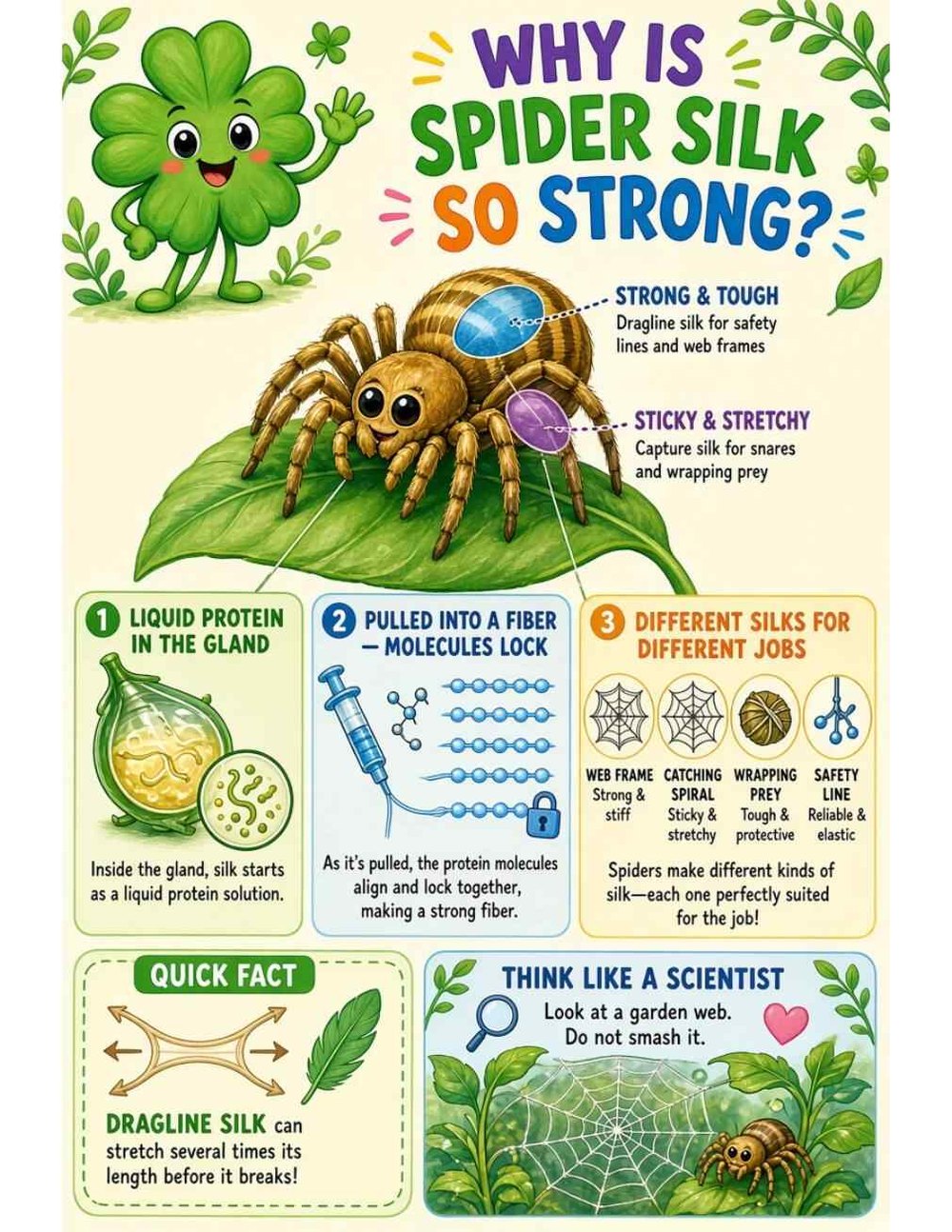
Page from A Million Whys Book 1
More fun facts
- Spider silk can be up to 100 times tougher than the same amount of steel.
- It is about twice as tough as Kevlar, the fiber used to make bulletproof vests.
- Spiders can spin different kinds of silk, and some are tougher than others.
- In a round orb web, the toughest silk makes the spokes that run out from the center.
- Silk proteins are called spidroins. They form in the spider's abdomen as a thick liquid.
- Body parts on the spider's rear end, called spinnerets, spin that liquid into threads.
- Scientists have used bacteria to make an artificial spider silk that is stronger and tougher than what some spiders make.
- Silkworm silk is used for fabric, but scientists study spider silk because it is much tougher.
Sources: Science News Explores, Science News Explores
Questions kids ask
Is spider silk stronger than steel?
For the same amount, spider silk can be as much as 100 times tougher than steel.
Where does spider silk come from?
Silk proteins form as a thick liquid in the spider's abdomen, and spinnerets on its rear end spin it into threads.